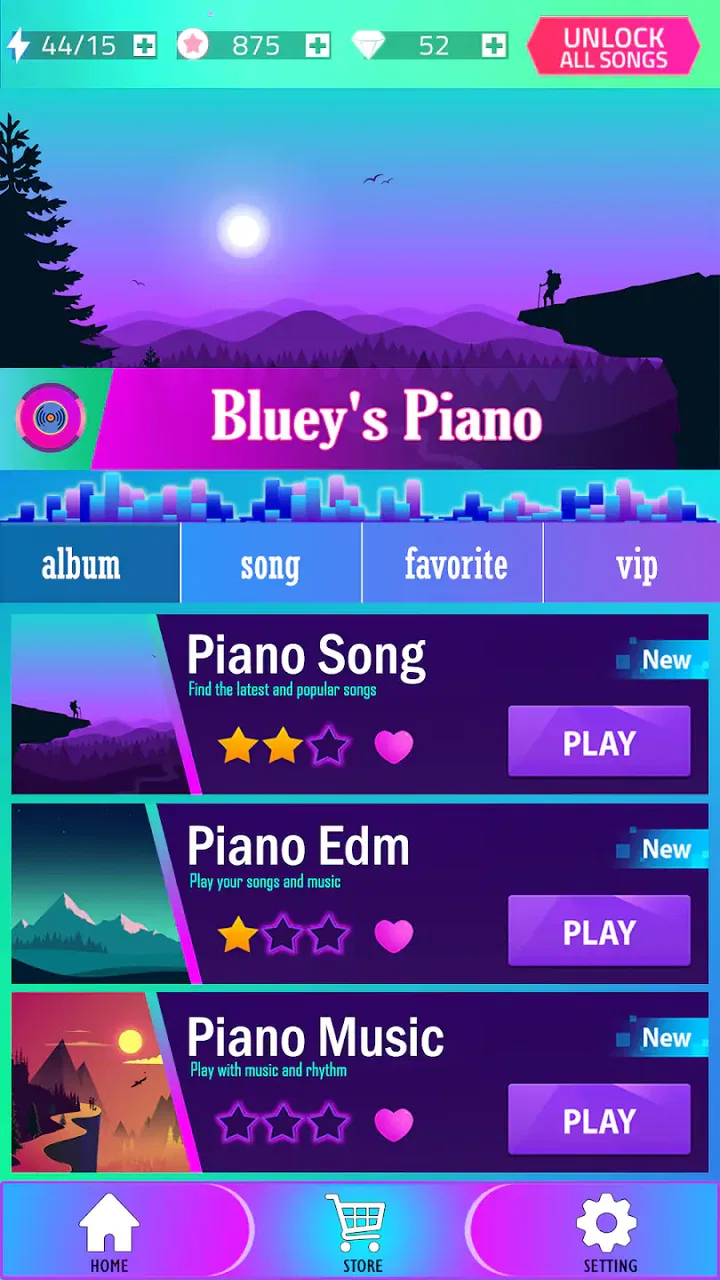
Piano Bluey's Tiles Game
- 2.8
- Rating
- 50.00K
- Installs
- Free
- Price

 Analysis by App-foxy
I spent time with Piano Bluey's Tiles Game as a lightweight music game, and my first impression was that it aims for immediate play rather than a deep learning experience. The title points clearly toward piano-style tile tapping, while the store description is simply “Piano Bluey's,” so the appeal depends heavily on how comfortable you are discovering the experience for yourself. It is free, rated for Everyone, and comes from Slow_Play-game, which makes it easy to approach if you want something casual rather than a serious piano simulator.
That simplicity is both its attraction and its main limitation. I can imagine opening it for a short break, testing my reactions, and putting it away without needing to study a complicated rule set. At the same time, players who expect a polished rhythm platform with extensive explanations, customization, or a broad accessibility menu may find the experience more basic than they hoped. My review focuses especially on how readable, manageable, and usable the game feels in different everyday situations.
How clearly the game presents its play experience
I find the game’s clearest promise in its direct, tile-focused interaction: it asks me to watch the screen and respond, rather than learn a larger system first. That can make a quick trial feel approachable, but it also puts a lot of weight on visual clarity and comfortable tapping. In the next section, I look at how that simple idea shapes the moment-to-moment experience.
You May Also Like

 AccuWeather: Weather Radar
AccuWeather Review: A Quick, Clear Forecast for Everyday Decisions
For everyday plans, the best forecast is the one you can understand quickly. AccuWeather makes rain timing, radar, and local conditions easy to act on, with a few trade-offs.

 Hill Climb Racing
Why Hill Climb Racing Still Turns Crashes Into One More Run
A tiny car, a bumpy hill and one more upgrade: Hill Climb Racing keeps resurfacing because its simple chaos makes every near-miss feel personal.

 AliExpress - Shopping App
AliExpress Makes Global Shopping Feel Personal, but Shoppers Bear the Risk
AliExpress turns a global marketplace into a pocket-sized discovery engine. Its reach is useful, its shopping loop compelling, and its trade-offs easy to miss.

 Lords Mobile: Kingdom Wars
Lords Mobile Is a Kingdom-Building Routine, Not a Quick Match
A case-by-case verdict on the building, battles, device demands, and social commitments that make Lords Mobile rewarding for some players and exhausting for others.

 PDF Scanner app - TapScanner
TapScanner Makes Paperwork Easier to Capture, Check, and Share
TapScanner makes scanning with a phone feel less like a rescue operation and more like a dependable step in getting work done. Its capture tools are useful, though not flawless.

 Block Blast!
 Shows How Much a Puzzle Game Can Leave Out
A quiet grid game shows why puzzle players increasingly value instant clarity, repeatable skill and low-pressure play—and where the genre still needs to catch up.
More From Our News Desk
View All News


Readability and navigation at first launch
The strongest part of a piano-tile concept is usually its visual directness. The player looks for the active tiles and responds to them, so the central interaction can be understood much faster than a game filled with menus, inventories, or layered objectives. In my experience, this makes Piano Bluey's Tiles Game approachable for someone who does not regularly play mobile games. You do not need to understand a fictional world or remember a long sequence of instructions before trying it.
That does not mean every part of the experience feels equally self-explanatory. The store presentation gives very little context beyond the short “Piano Bluey's” description, so a new player may need to rely on the opening interaction rather than a detailed tutorial. For confident users, that is fine: tapping and observing the result is enough to begin. For younger players, older adults, or anyone who prefers explicit guidance, a clearer explanation of the objective would make the first minutes less uncertain.
I also think visual simplicity should not be confused with excellent readability. A tile game can look clean while still becoming difficult to follow when several elements move quickly or when the screen is affected by glare. Players with reduced contrast sensitivity may need to test the game personally to decide whether the tile distinction is comfortable. The most useful approach is to try it in the same lighting where you expect to play, rather than judging it only from a bright indoor setting.
Navigation matters beyond the main play area. Casual games are easier to live with when restarting, pausing, or leaving a session feels obvious. Piano Bluey's Tiles Game is best suited to people who appreciate a focused, uncomplicated interaction. If you frequently need to move between screens, adjust many settings, or review detailed progress, this is not the type of music game I would choose first. Its value is in getting to the tapping experience quickly, not in offering a large management layer around it.
What the visual design means for different players
For a player with typical vision and steady attention, the tile format is naturally understandable. The game communicates through position, movement, and timing instead of long text passages, which reduces the reading burden. That can help someone who is not fluent in English or who simply wants to play without stopping to interpret instructions.
There is a trade-off, though. A design built around visual targets may place more pressure on people who have difficulty distinguishing colors, tracking motion, or shifting attention across the display. I would not describe the game as broadly accessible to every visual ability based only on its basic concept. If you need large targets, alternative color schemes, spoken guidance, or a dedicated high-contrast mode, you should treat those needs as important decision points and test the game before relying on it.
One practical tip is to hold the device in a stable position and avoid playing with the screen tilted sharply. That sounds obvious, but it can make a noticeable difference in a game where the location of a tile is the main information. A stand or a firm two-handed grip may also help players who find it tiring to keep the phone balanced while tapping. This is not a special feature of the game; it is a simple way to reduce unnecessary visual and physical strain.
Motor and sensory considerations during play
The tapping mechanic is easy to describe, but ease of understanding is different from ease of execution. A player needs to identify the target, move a finger to it, and respond at the right moment. That combination can be enjoyable for people who like quick reactions, yet it may become frustrating for anyone with tremors, limited finger control, joint pain, or slower motor responses.
I would be cautious about recommending it as a universally comfortable game for users with motor impairments. The core challenge appears tied to accurate, timely touches, and there is no reason to assume that a player can replace those gestures with a keyboard, switch, voice command, or another input method. If precise tapping is difficult for you, the game may still be worth a brief trial, but I would not make it your main choice without confirming that the interaction feels manageable on your device.
Screen size changes the physical experience as well. On a larger phone, targets may be easier to separate and reach, while a compact display can make every mistake feel more connected to finger placement. A tablet could offer more room, but I would not assume that the layout or responsiveness will feel identical across devices. My advice is to test the game with the hand you actually intend to use and notice whether repeated tapping creates tension in your thumb or wrist.
Sensory comfort is another important part of the decision. Music games often combine movement, sound, and repeated visual changes, which can be stimulating even when the rules are simple. If you are sensitive to rapid motion, strong contrast, or repetitive audio, start with a short session and use the device’s ordinary sound controls if needed. I would avoid playing in a place where you must remain highly alert to your surroundings, because concentration on moving tiles can pull attention away from nearby activity.
Using it in ordinary situations
The clearest everyday use case is a short, informal break. I can see someone opening it while waiting for a friend, relaxing after work, or looking for a small distraction that does not require a long story or a complicated setup. Since the game is free, there is little financial barrier to trying it, and the Everyone age rating makes it suitable to consider for a broad family audience. That rating does not guarantee that every child will find the speed or sensory presentation comfortable, so younger players may still benefit from supervision.
It is less suitable when your surroundings demand quiet concentration or quick attention elsewhere. On public transport, for example, a player may enjoy a brief session, but crowded conditions can make precise tapping awkward and make it easier to miss what is happening around them. In a waiting room, I would keep the volume low and avoid assuming that the musical element will be welcome to others. The game works best when the player can give the screen a modest amount of uninterrupted attention.
For shared family use, the game could function as a simple turn-taking activity. One person can try to improve a run while another watches, especially if the group enjoys rhythm and reaction challenges. However, it is not the same as a collaborative music-making app. I would choose it for quick individual turns, not for composing together, teaching formal piano technique, or building a structured lesson around music.
There is also a useful distinction between entertainment and practice. Repeated tile tapping may help a player become more familiar with visual timing and hand movement, but I would not treat that as piano instruction. Someone who wants to learn notes, scales, posture, or real keyboard technique would be better served by an educational piano app or an actual keyboard-based tool. This game is closer to a reaction pastime with a piano theme than a substitute for music education.
Where it sits beside familiar alternatives
Compared with a full rhythm game, Piano Bluey's Tiles Game feels like the simpler option for someone who wants less setup and less commitment. Larger rhythm titles often provide richer presentation, broader song collections, progression systems, or more elaborate feedback. Those extras can be motivating, but they can also create more menus and distractions. If your priority is a quick tile-focused session, the smaller scope may be welcome.
Compared with a piano-learning app, the difference is even clearer. Learning tools usually explain musical concepts and connect exercises to a longer practice plan. This game is not the choice I would make for a student who wants measurable instruction. Its strength is immediate reaction-based play, while the alternative is stronger for building knowledge and technique.
Compared with a completely offline, non-musical puzzle, the piano theme gives the session a different mood. The visual target challenge remains central, but the musical framing may make repeated attempts feel more lively. On the other hand, if you dislike rhythm pressure or prefer calm logic puzzles, the theme will not solve that basic mismatch. Choosing this game should come from enjoying the combination of tiles and music, not simply from wanting any free game.
Practical limits and points of friction
The public response suggests a mixed reception: the game holds an average rating of 2.8 from around two hundred ratings, with only a small number of written reviews. I read that as a reason to keep expectations measured. It has attracted over fifty thousand installs, so it is not an unknown experiment, but its reach does not by itself prove that the experience will suit your device, reaction speed, or accessibility needs.
The current version is 7.1, and it supports devices running Android 6.0 or later. That broad compatibility is useful for people using older Android hardware, although compatibility alone does not tell me how smooth the game will feel on every phone. Older devices can differ in touch response, display quality, and performance. If your phone already struggles with animated apps, I would test a short session before deciding whether it deserves a permanent place on your home screen.
Another limitation is the narrowness of the concept. A player who enjoys variety may quickly want additional modes, deeper progression, or more control over the experience. I would not install it expecting the breadth of a major music-game catalog. Its free price makes experimentation easy, but free access does not remove the cost of time: if the central tapping loop does not feel satisfying within the first few sessions, there may be little else here to change your mind.
Players should also think about comfort over longer runs. Even a basic tapping game can encourage repeated movements, especially when a player is trying to beat a previous result. I recommend taking breaks and switching hands only if that feels natural rather than forcing a posture. Someone with an existing hand or wrist problem should be particularly careful, because a casual game is not worth aggravating discomfort.
Who I would recommend it to
I would recommend Piano Bluey's Tiles Game to someone who wants a free, approachable music-themed distraction and enjoys reacting to visual targets. It makes sense for a casual player who does not want to learn a complex ruleset, and it can work well as a short break between other activities. The Everyone rating also makes it a reasonable candidate for families to try together, provided each player is comfortable with the visual pace and tapping demands.
I would be more selective for people who need accessibility controls, slower timing, alternative input, spoken instructions, or strong visual customization. I would also steer serious music learners toward a dedicated piano-teaching app, and competitive rhythm players toward a more feature-rich game with a stronger progression structure. Those are not failures of this title; they are situations where its focused design is simply not enough.
If you decide to try it, begin with a short session in good lighting, keep the device stable, and pay attention to whether the targets remain easy for you to distinguish. Test the sound at a comfortable level rather than assuming the music will suit every environment. Most importantly, judge the game by the feel of its central interaction: if tapping the tiles is satisfying, the uncomplicated format can be a strength; if it feels unclear or physically demanding, extra attempts are unlikely to fix that.
My inclusive verdict
My overall view is cautiously positive for the right audience. Piano Bluey's Tiles Game is a straightforward, free music game from Slow_Play-game that can provide a quick reaction challenge without asking the player to learn a large system. Its modest presentation may help people who prefer direct play, but the same simplicity leaves fewer obvious answers for users who need adjustable speed, alternative controls, or extensive guidance.
I appreciate that the concept is easy to approach, yet I would not call it universally accessible. Visual tracking, timing, touch precision, and sensory comfort all influence whether the game feels welcoming. The best fit is a player who can comfortably follow moving tiles and enjoys short, focused sessions. For everyone else, especially people with specific access requirements, a more configurable rhythm or piano app is likely the safer recommendation.
In the end, I see it as a small game to sample rather than a complete music platform. Its free availability and broad age rating make trying it simple, while the mixed average rating is a useful reminder to keep expectations realistic. If you want a no-cost piano-themed tapping experience and value immediacy over depth, it is worth a look. If you need instruction, collaboration, extensive customization, or carefully designed support for different abilities, I would choose an alternative built around those priorities instead.
FAQs for Piano Bluey's Tiles Game
01What is Piano Bluey's Tiles Game?
Piano Bluey's Tiles Game is a rhythm-based music game available on Android and iOS devices. Players tap on tiles as they appear on the screen in time with popular tunes from the beloved Bluey series. It's designed to be engaging for all ages, blending fun gameplay with musical enjoyment.
02Is Piano Bluey's Tiles Game suitable for kids?
Yes, Piano Bluey's Tiles Game is designed to be kid-friendly. It features simple controls and colorful graphics that appeal to children. The music selections are family-friendly, often including songs from the Bluey series that are popular among young audiences, ensuring a safe and enjoyable experience.
03Does the game require an internet connection?
Piano Bluey's Tiles Game can be played offline once downloaded, making it convenient for on-the-go entertainment without the need for constant internet access. However, some features, such as updates or additional song downloads, may require an internet connection.
04Are there in-app purchases in Piano Bluey's Tiles Game?
Yes, Piano Bluey's Tiles Game offers in-app purchases. Players can buy additional song packs, remove ads, or unlock premium features. While the basic version is free, these purchases enhance the gaming experience, so parental controls are recommended for managing purchases.
05What devices are compatible with Piano Bluey's Tiles Game?
Piano Bluey's Tiles Game is compatible with most modern Android and iOS devices. It requires a minimum operating system version, usually specified in the app store listing. For the best experience, ensure your device meets the recommended specifications and has sufficient storage space.
Pros
- Engaging gameplay for all ages.
- Simple controls
- easy to learn.
- Visually appealing with vibrant graphics.
- Regular updates with new songs.
- Offline mode available for on-the-go play.
Cons
- Contains frequent ads during gameplay.
- Limited free song selection.
- In-app purchases can be pricey.
- No multiplayer mode available.
- Requires internet for some features.

Piano Bluey's Tiles Game
Gallery